
The -Inhabited- Threshold
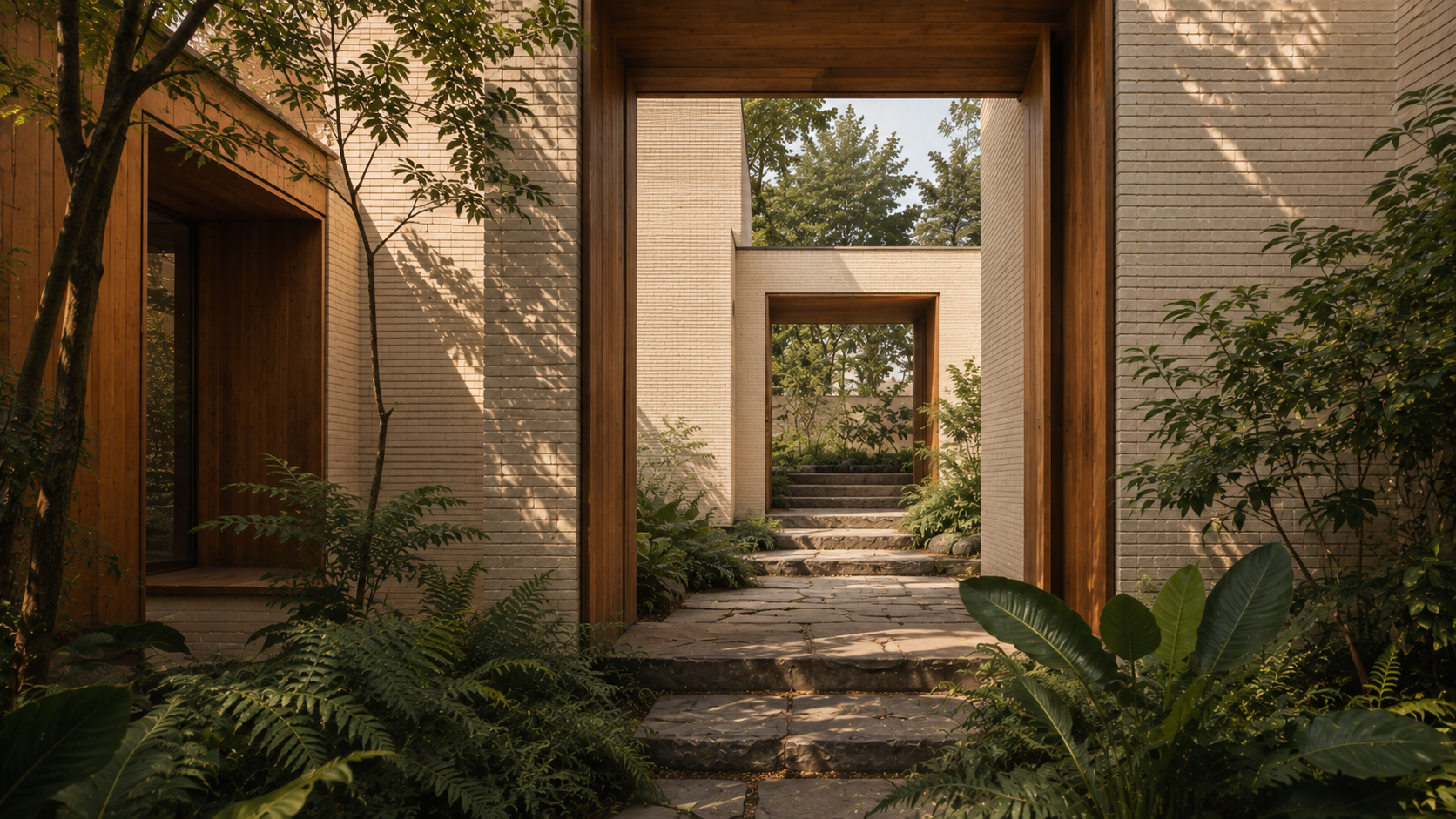
A few days ago I came across one of our projects again. It’s a garden at dusk, the light low and golden, a group of people talking among the trees, the same space a couple uses in the morning, sitting on a large stone, or later in the day, when a friend leans comfortably against a lit doorway.
No one is fully inside or fully outside the house, they’re in that in-between that has no name of its own but that we recognize the moment we live it. That in-between, that inhabited threshold, is for me the quiet heart of any project, the in-between spaces.
I’ve spent years studying urban quality of life at a larger scale, the plazas, the sidewalks, the way a city receives a family. The IQOL, the urban quality of life index I developed, also measures that, how public space makes a city livable. But that same question, applied at the most intimate scale, is the one that interests me today, the one about domestic space, because a house also has its own plazas and sidewalks, its own in-between spaces, and that’s where much of whether a place ends up feeling alive or merely built gets decided.
The French philosopher Gaston Bachelard devoted much of his work to thinking about these smaller places, the corner, the drawer, the threshold, as the true keepers of a house’s memory and imagination. Reading him confirmed something I already sensed, that a corner isn’t a geometric leftover but a refuge, a place where the body settles and the imagination expands.
When I design a patio, or a hallway with a tree, I think about that, about how that small space can become a corner in Bachelard’s sense, a place where someone chooses to stay without anyone asking them to.
The Norwegian architect Christian Norberg-Schulz, who I often cite when I talk about genius loci, distinguished between geometric space and what he called existential space, the space we actually inhabit and that, above all else, organizes our experience of the world.
A well-oriented patio, a shadow in the right place, aren’t decorative details, they’re the way a house’s existential space becomes legible to the person living in it. It’s the same idea I apply at the scale of the city, adapted to the scale of a family.
The Finnish master Juhani Pallasmaa wrote about architecture as a multisensory experience, not only a visual one, and there I find the technical explanation for something I’ve known intuitively for years, that a material that ages well, stone, wood, exposed brick, communicates something through touch and through time that no render can capture.
That’s why vegetation is far from being mere decoration in this line of work. It’s shade, it’s scent, it’s sound, a form of architecture that changes with the seasons and with the years.
Technically, this comes down to a few well-considered variables. Orientation defines when light comes in and when it should be filtered. Materiality defines how a place feels to the touch and how it ages with use. Vegetation defines the immediate microclimate, shade in summer, the scent after rain, the sound of wind through the leaves. And there’s a fourth, less obvious variable, gradation, the fact that a good in-between space doesn’t separate inside from outside all at once, but builds a sequence of thresholds, a porch, a gallery, a wide step, each with its own degree of intimacy.
This same logic of gradation is what I apply when I think about a plaza or a sidewalk within a family-centered urban plan, as I like to call it. A family-friendly city isn’t the one with the most parks, it’s the one that gets its own in-between spaces right, the wide sidewalk where a kid can play near an adult, the semi-covered passage between public transit and home, the pocket plaza between two buildings.
The house and the city share, at bottom, the same question, where people choose to stay when no one tells them to.
So I return to that photo of the garden at dusk. None of those people are posing for architecture, they’re simply living in it, without realizing it.
This is, for me, one more proof that an in-between space works when it stops being noticed as design and starts feeling like the most natural place in the world to stay.